Hair · 4 September 2026
Inviso-Neo DHI vs FUE: why the pen changes the result
Almost every transplant in India is an FUE. It is not a bad procedure — but it has three specific limits, and they are why people can spot a transplant across a room.

Almost every hair transplant performed in India is an FUE. It is the default, and it is not a bad procedure — but it has three specific limitations, and they are the reason so many people can spot a transplant across a room.
First, the donor area
Every plan starts at the back of the head, in the band of hair running from one ear to the other.
Look at an older man who has lost most of his hair and you will still see that band. It survives because DHT — the hormone behind male pattern baldness — does not act on it. Hair taken from there keeps that resistance after it is moved. That is the whole basis of a transplant: not creating new hair, but relocating hair that is programmed not to fall.
How FUE actually works
Grafts are plucked individually from the donor area and held in a solution — GFC, PRP, or plain saline depending on the clinic. Only once the entire extraction is finished does implantation begin.
Its genuine advantage is real and worth stating: no strip, no stitches, no cuts. For the patient that is a much easier day than older techniques.
Where FUE loses you
Three things, and they compound.
- The needle size. Most FUE is done with a 21 to 26 gauge needle — wide enough that the pores cannot close invisibly, which is why the small marks are still visible once the hair grows in.
- Air exposure. Between extraction and implantation the grafts sit outside the body, and time out of the scalp costs survival.
- The plucking itself. Extraction by plucking is an aggressive movement, and grafts are damaged in the process.
Put together, the density that survives is typically around 60 to 70 per cent of what was moved. That gap is why patients are often quietly disappointed: the transplanted area never quite matches the donor area it came from, and the result reads as thinner than expected.
What Inviso-Neo DHI changes
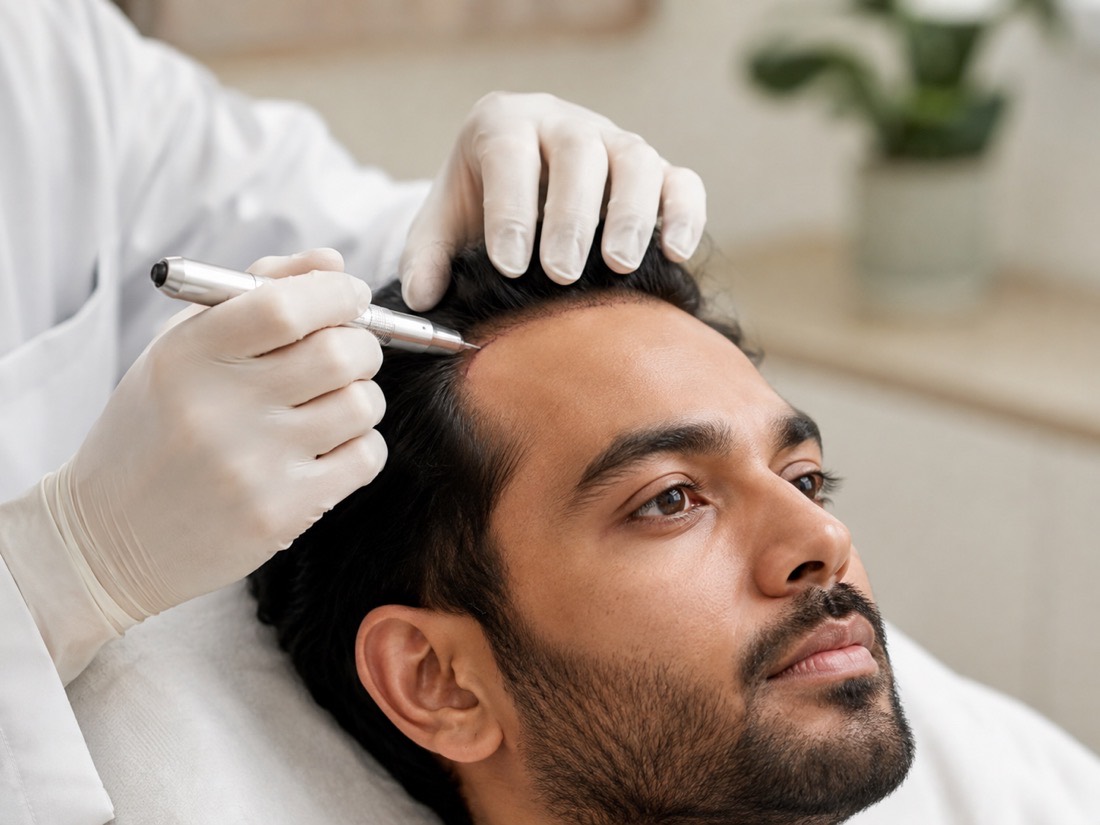
With Inviso-Neo DHI the graft is extracted with a pen and implanted with the same instrument — it never touches the air. Removing that exposure removes one of the main reasons grafts fail to take, so a far higher proportion of what is implanted survives.
The incision is made with a 6 to 10 gauge pen rather than a 21 to 26 needle. At that size the pores close without leaving the marks people notice afterwards.
The part almost nobody discusses: direction
Look at how hair grows on a baby. It radiates from a whorl at the crown — a chakra — and flows back to front.
Most FUE implants front to back, because that is the easier way to work. The hair grows, but it grows in the wrong direction. Sometimes it looks merely flat; sometimes strands run against each other and it looks odd. You notice it most after a haircut, when the hair is asked to sit a particular way and will not.
The pen allows each graft to be placed at a chosen angle and direction. Which grafts go where, at what angle and what density, follows a worked-out ratio rather than a uniform pattern — the Graft Personalisation Ratio. It is the difference between hair that has been installed and hair that looks like it grew there.
FUE and Inviso-Neo DHI, side by side
| Standard FUE | Inviso-Neo DHI | |
|---|---|---|
| How the graft is taken | Plucked from the donor area | Drawn with the pen |
| How it is put back | Implanted after all extraction finishes | Implanted by the same pen, straight away |
| Time outside the body | Held in GFC, PRP or saline until implantation | None — the graft never contacts air |
| Incision size | 21 to 26 gauge needle | 6 to 10 gauge pen |
| Marks afterwards | Small pores usually visible once hair grows in | Pores close without the tell-tale marks |
| Surviving density | Typically 60 to 70 per cent of grafts moved | Substantially higher — no air exposure, gentler extraction |
| Direction of growth | Commonly front to back, uniform | Angle and direction chosen per graft |
| Placement pattern | The same pattern for every head | Graft Personalisation Ratio, mapped to your face |
| Maximum grafts | Varies by clinic | Up to 8,000 |
| Stitches or cuts | None | None |
| After a haircut | Hair can sit against itself and look odd | Sits the way the rest of your hair does |
The numbers
- Up to 8,000 grafts can be extracted.
- Incisions at 6 to 10 gauge, against 21 to 26 in standard FUE.
- No air contact between extraction and implantation.
- Direction and density planned per graft rather than uniformly.
The honest summary
FUE is not a bad operation. It is a reasonable procedure with known limits — visible pores, roughly 60 to 70 per cent surviving density, and hair that often runs the wrong way. Inviso-Neo DHI is designed against each of those limits.
The aim is a hairline nobody has any reason to ask about, including the barber, who sees more scalps than anyone. Results vary from patient to patient, and what is achievable for you depends on your donor area and your stage of loss. That is what the consultation is for — and if a transplant is not the right answer for you, we will say so.